Sensory Substitution
An early-stage research project exploring how information normally received through one sense can be translated into another to support independence and everyday awareness.
Project Overview
Sensory loss can have a severe impact on a person's daily life. This project investigates whether information from a lost sense can be delivered in a new way to improve independence and quality of life.
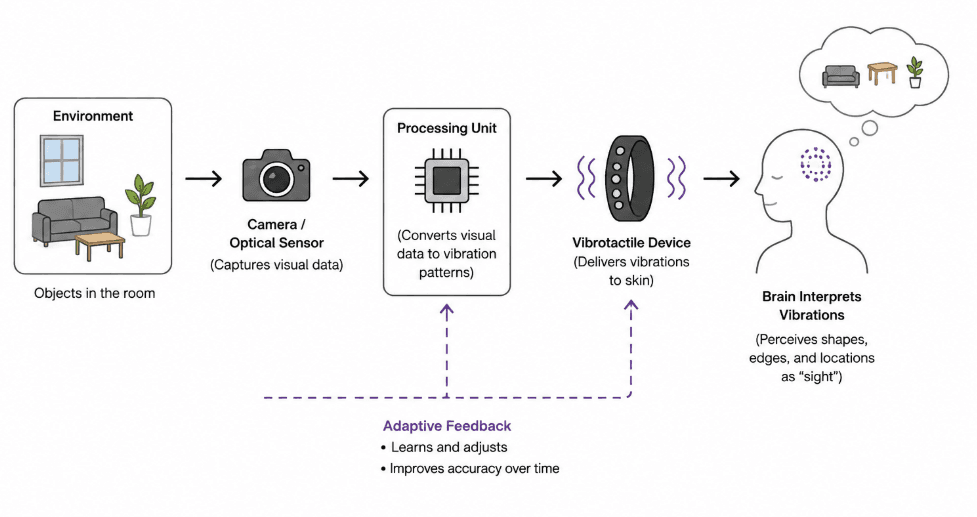
Research suggests that people can learn to interpret familiar information when it is presented through a different sensory channel. For example, optical data describing objects in a room could be converted into patterns of vibration on the skin, allowing the wearer to build an understanding of shapes, edges, and locations through touch.
At a Glance
How Sensory Substitution Works
Capture
A camera or optical sensor collects information about the environment.
Translate
A processor converts visual features into structured vibration patterns.
Interpret
The wearer learns to associate those patterns with objects and locations.
From Vision to Touch
The proposed system uses a camera, a processing unit, and a vibrotactile wearable to preserve useful environmental information while changing the way that information reaches the user.
Research Direction
What We're Exploring
The first challenge is deciding which parts of a visual scene are most useful and how to represent them through touch without overwhelming the wearer. Shapes, edges, distance, and location may each require a clear and learnable vibration pattern.
Early Priorities
- Information mapping: translate visual features into distinct tactile cues.
- Adaptation: adjust patterns as the user learns and provides feedback.
- Wearability: keep the device comfortable and practical for daily use.
This project is in early research. Its goal is to investigate supportive technology and it is not presented as a replacement for clinical care or an existing sensory aid.
Interested in Sensory Substitution?
We're excited by the possibilities of translating information across the senses. Get in touch if you'd like to contribute to the research, prototyping, or human-centered design of this project.